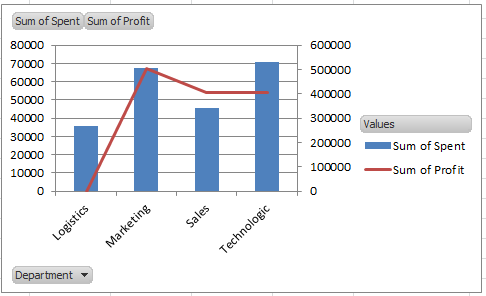
Charting - Primary and Secondary Y-Axes: Changing where one crosses I'm displaying two sets of data in a single chart by using a bar series and a line series. The bar series is associated with the left vertical axis and is fine (but it includes negative values so the horizontal axis is in the center of the chart - this is ok). Make the finishing touches: set the maximum value for the secondary vertical axis to 100%, make the bars wider, and optionally, hide the legend. The steps are basically the same as in Excel 2013 described above.
In Excel 2007/2010 1. Click the chart to display Chart Tools in the Ribbon, then click Layout >Axes.
Notice screenshot: 2. In Axes list, select the axis you wish to conceal, and then click None. Find screenshot: After that the axis will end up being concealed. In Excel 2013 1. Click on the chart to display Chart Tools in the Ribbon, then click Design >Put Chart Component.
Observe screenshot: 2. In the checklist, click Axes, and then select the axis you would like to conceal. After that the axis will become hidden.
Get rid of graph áxis with VBA If yóu are usually interested in VBA program code, you can use the follow program code to remove the axis. Choose a graph and hold on Alt + N11 keys to open Microsoft Visual Basic for Applications window. Then click Place >Module to place a Component windows, and then duplicate the following VBA into it. VBA: Get rid of A axis from graph. Subwoofer XLabelHidden 'Updateby20140911 Dim xChart As Graph Dim xChartAréa As ChartArea lf VBA.TypeName(Software.Choice) = 'ChartArea' After that Set xChartArea = Application.Selection Place xChart = xChartArea.Parent With xChart.Axés(XlAxisType.xlCategory).TickLabeIs.Font.ColorIndex = 2.Background = xlTransparent End With Finish If End Subwoofer 3.
Click Operate or push N5 to run the program code. Then the selected graph's Times axis is definitely removed. Take note: This VBA program code only works on removing Times axis, and the taken out axis cannot be shown again. Recommended Efficiency Equipment Bring convenient dividers to Excel and additional Office software, simply like Chrome, Firefox and brand-new Web Explorer.
Raise your efficiency in 5 minutes. Put on't need any particular abilities, save two hours every day! 300 New Functions for Excel, Make Excel Very much Quick and Powerful:. Merge Cell/Rows/Columns without Losing Data. Mix and Consolidate Multiple Bedding and Workbooks.
Compare and contrast Ranges, Copy Multiple Ranges, Convert Text to Day, Device and Currency exchange Conversion. Count number by Shades, Paging Subtotals, Advanced Kind and Super Filter,. More Go for/Insert/Delete/Téxt/Format/Link/Commént/Workbooks/Worksheets Tools.
Microsoft Excel® can be a popular graphing device utilized by habits analysts to visually display information. Nevertheless, this program is not always friendly to the graphing promotions utilized by behaviour analysts. For instance, adding stage change lines has typically been recently a cumbersome process concerning the installation of line items that do not shift when brand-new data is included to a graph. The purpose of this article can be to describe a new way to add phase change lines that shift when new data is included and when charts are usually resized. Several behavior analysts depend on Microsoft Excel® to chart and visually analyze information. Usually, Microsoft Excel® allows behavior experts to precisely meet the graphing promotions used by the industry and utilized in practice.
However, there are a several issues inherent to the software program that avoid it from displaying behavioral information in an accurate and easy way. Including phase shift ranges to Microsoft Excel® charts is conveniently one of the most troublesome factors of this software. Phase modification lines are not really intuitive to the software, which means that additional workarounds need to end up being utilized to include these components to graphs. The nearly all typical workaround referred to in the literature involves placing line objects on top of charts (Dixon et al; Pritchard ).
Unfortunately, line objects can be troublesome to align within a chart and, more importantly, do not proceed when fresh data is certainly included or when the chart is resized. This means that behavior analysts are usually pressured to proceed their phase change outlines whenever they include new information or resize their charts. Given how often behavior analysts upgrade their graphs and the likelihood that they are simultaneously sustaining several charts for multiple customers, this minor irritation can rapidly turn into a significant waste materials of clinical time. Vanselow and Bourrett lately advocated for an alternative method for adding phase transformation ranges. The technique that they referred to involves graphing data as scatterplots and plotting phase change ranges as error bars. While this technique seems to end up being a much better choice to inserting collection stuff, there are some significant limitations.
First, when making use of this technique, phase modification ranges can just be placed between data points when the x-axis will be an integer (at the.g., periods). In additional terms, this method does not really function when the x-axis beliefs are schedules. 2nd, this technique requires habits experts to graph their information as scatterplots as compared to the “designated range graphs” as described in the other tutorials already mentioned. Third, this technique requires actions analysts to place two distinct beliefs for thé x-axis ánd y-axis for éach phase change collection, which can end up being cumbersome. Thankfully, there is certainly another way to include phase change lines directly into Microsoft Excel® charts using combined charts, gradients, and transparency options. This method produces phase shift ranges between information points regardless of the x-axis values that move when brand-new data is definitely included and immediately resize when the height and breadth of a graph are changed. The brief task studies that adhere to have been applied to Microsoft ExceI® 2007 and 2013 for PC and Microsoft ExceI® 2011 for Macintosh.
Although this technique has not been straight tested, these ways (with slight modifications) may furthermore work in additional versions of Microsoft Excel® that support combined charts, gradients, and openness choices. These task analyses should not be considered extensive graphing lessons that evaluation all graphing conferences followed by conduct analysts.
Instead, they should just be regarded supplementary guidelines that provide an choice way to add phase modification ranges to graphs produced in Microsoft Excel®. Two task analyses are usually provided below. The audience is motivated to use the job analysis that many closely fits the edition of Microsoft ExceI® that they make use of for graphing. REPEAT the methods in this section to remove any extra data pathways crossing stage change outlines. The purpose of these brief task analyses was to expose a novel method of placing phase switch outlines into Microsoft Excel® range graphs. Additional editing to go with behavior analytic graphing promotions should furthermore be used (at the.g., including axis and stage change brands, formatting data series, resizing graphs, getting rid of gridlines, etc.) where required. Readers are prompted to review the lot of excellent comprehensive graphing tutorials obtainable if they are usually new with how to have out these methods (discover Dixon et aI; Pritchard; Vanselow ánd Bourrett ).
This remedy for incorporating phase switch lines will be beneficial for various reasons. First, the phase change collection is included directly into the graph, meaning that the chart can become copied and pasted into some other programs without requiring to be concerned about transporting over exterior line objects. 2nd, phase change lines immediately shift with the chart when it will be resized. 3 rd, the stage change range appears between two information factors without any overlap. Fourth, new information and phase change outlines can be easily added once the phase change line has happen to be formatted. Junior high, this technique works irrespective of the ideals utilized in the x-axis (age.g., classes or dates).
Finally, these measures only need to be followed once. After a phase change range has long been formatted using the actions described, it can end up being saved as a template and used for long term charts. There are a couple of restrictions to this solution that bear mentioning. Very first, this technique does not really enable for the choice to make dashed or speckled phase shift lines. Visitors serious in this function should think about the series object method or the mistake bar method mentioned earlier. Second, this option does not really tackle the related problem behaviour analysts encounter when including phase switch labels to their graphs.
Secondary Vertical Axis Excel
Currently, the only method referred to to tackle this issue requires pasting a téxtbox within the graph. Unfortunately, this technique is subject matter to the same limitations as the range object alternative, as the text message boxes perform not shift when fresh data is definitely added or when the chart is definitely resized. Nevertheless, also with this restriction, the technique referred to herein will probably conserve a excellent deal of period in the lengthy phrase, as behaviour experts will be needed to just move stage change labels as contrary to also needing to modify phase shift lines whenever a chart is updated. Microsoft Excel® is usually a well-known software plan utilized by behaviour experts to graph and visually analyze information. Current options to adding phase switch ranges within Microsoft Excel® have got notable limitations.
Excel 2013 Secondary Vertical Axis
The short task analyses provided tackle these limitations and offer a new way to add phase modification lines using combined graphs, gradients, and openness options. Using this technique, behavior analysts can rapidly include phase switch lines between two information points directly into their graphs saving period and effort when upgrading client information. Dixon Mister, Jackson JW, Small SL, Hornér-King MJ, Mui Kér Lik In, Garcia Con, Rosales L. Developing single-subject design charts in Microsoft Excel™ 2007. Paper of Applied Conduct Analysis. 2009; 42(2):277-293.
Doi: 10.1901/jaba.2009.42-277. Pritchard M. A decade later: generating single-subject style graphs with Microsoft ExceI 2007™ The Conduct Analyst Today. 2009; 9:153-161.
Doi: 10.1037/l0100655. Vanselow NR, Bourrett JC.
Online interactive tutorials for producing graphs with Excel 2007 or 2010. Behavior Evaluation in Practice. 2012; 5(1):40-46.